
The Load vs. Capacity Model
Most chronic issues with burnout, fatigue, stress, and pain aren’t random. They often happen when total life load exceeds recovery capacity over time. This page helps you see the pattern clearly—so you can make grounded changes without guessing.
A few minutes. Clear insight. No pressure.
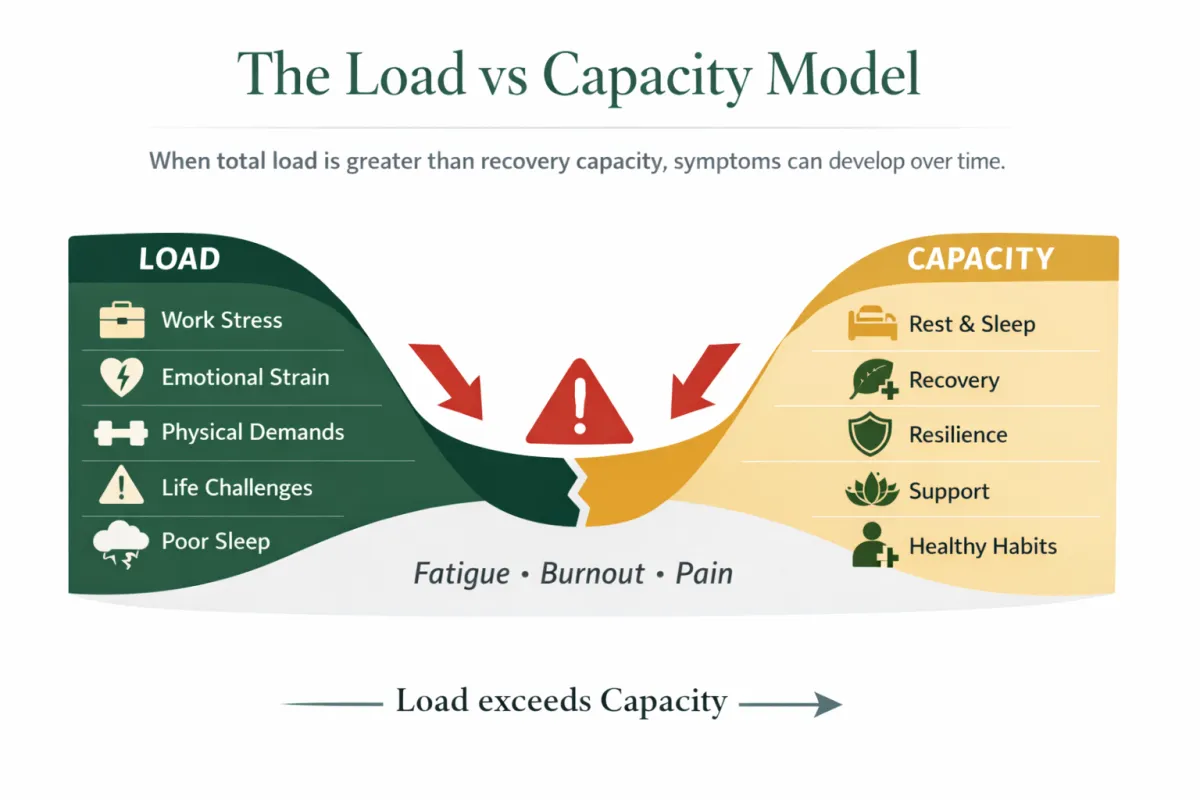
What is “Load”?
Load is the total demand placed on you—everything your body and mind are being asked to carry. Some of it is obvious. Much of it is quiet and constant.
- Physical demands (training, repetitive work, illness, under-fuelling)
- Mental pressure (decision fatigue, constant problem-solving, always “on”)
- Emotional strain (conflict, grief, caretaking, feeling responsible for others)
- Environmental stress (poor sleep environment, noise, screens, commuting, time pressure)
- Accumulated responsibilities (workload, family load, financial strain, ongoing admin)
What is “Capacity”?
Capacity is your ability to meet life’s demands and still recover. It’s not fixed. It can rise with the right foundations, and it can shrink when you’re depleted—even if nothing “dramatic” has happened.
- Recovery time (true downshifts, not just “switching tasks”)
- Sleep quality and sleep consistency
- A steadier nervous system (less reactivity, easier calm)
- Resilience (how quickly you bounce back after strain)
- Margin (time, energy, and room to breathe)
- Support (people, routines, and environments that reduce load)
How imbalance develops
Most people don’t “break” overnight. The more common pattern is gradual: load rises, capacity quietly falls, and you adapt—until adaptation becomes strain.
1) Load increases
More demands, less time, more pressure—sometimes from “good” things too.
2) Capacity narrows
Sleep shifts, recovery gets crowded out, and your margin becomes thinner.
3) You adapt (for a while)
The system compensates. You keep functioning—until the cost shows up as symptoms.
Why symptoms appear late
A key realisation: the body is designed to keep you going. It can cover the gap for a long time—until it can’t.
- Compensation is normal: you borrow energy, push through, tighten up, and keep functioning.
- Early warning signs are often subtle: more effort for the same output, irritability, shallow sleep, slower recovery.
- Noticeable symptoms tend to arrive after the build-up: when the system has been running without enough margin.
Where this shows up
Different people feel the same imbalance in different ways. These are three common expressions.
Burnout
The sense that everything takes more effort than it should. Motivation drops, rest doesn’t land, and even small demands feel heavy.
Fatigue
Not just “tired”—more like your battery doesn’t recharge. Sleep may happen, but you don’t feel restored, and the day drains you faster.
Pain
Often a sign the system is guarded and sensitised. Tissues may be irritated, but persistence is commonly linked to stress, sleep, and reduced recovery capacity.
A simple visual of the model
When load climbs above capacity—and stays there—symptoms tend to begin. The point isn’t perfection. It’s restoring margin.
Read it like this: capacity is the steady line, load is the rising line, and the crossing point is where the costs usually start appearing.
What changes when you see this
The model doesn’t “diagnose” you. It helps you stop arguing with yourself and start making cleaner decisions about what to reduce, what to rebuild, and what to protect.
- Clarity replaces confusion: you can name the imbalance instead of chasing symptoms.
- Better decisions become possible: reduce load where it’s hidden and protect recovery where it’s fragile.
- Less trial and error: you stop relying on willpower and start restoring margin.
- More effective recovery: small, consistent inputs count when they match the real constraint.
Ready to map your load and capacity?
The assessment takes a few minutes. It helps you identify what’s contributing most to your total load, where capacity is being compressed, and what to focus on first.
Calm, practical, and focused on what matters most right now.

Load & Capacity
A simple model for understanding how load and recovery shape health.
This website provides educational information only and is not a substitute for professional medical advice.