
A calm, clear way to understand why you feel drained
Load & Capacity is a simple model that explains burnout, fatigue, pain and stress as what happens when life’s load quietly exceeds your ability to recover.
Created by chiropractor and health coach Peter Bennett to give you language and structure for what your body has been trying to tell you.
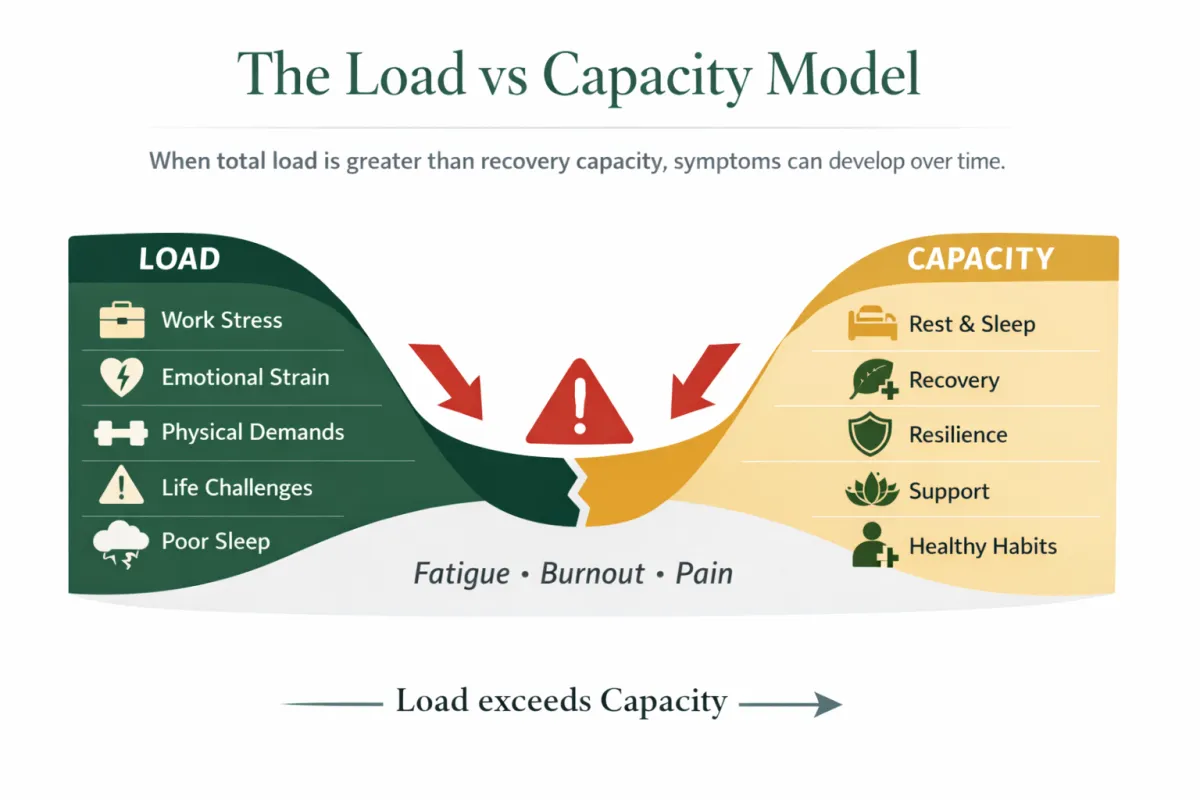
- Burnout, fatigue and pain often start long before you notice the symptoms.
- Your load includes more than work – it’s everything your body and mind have to hold.
- Capacity can be rebuilt once you see the full pattern clearly.
The Load vs Capacity model, in plain language
Load: everything that asks something of you
“Load” is the total demand on your system. Work deadlines, caring for others, training, worries about money, poor sleep, screens late at night – all of it adds up. Your body doesn’t separate them; it simply experiences the combined weight.
Capacity: how well you can recover and adapt
“Capacity” is your ability to handle that load and come back to balance. It includes your sleep quality, nervous system resilience, movement, nutrition, relationships, sense of safety and support – the things that restore you.
What happens when load stays above capacity
Problems like burnout, long-lasting fatigue, recurring pain or constant stress usually don’t come from one event. They build when your daily load sits above your capacity for weeks, months or years. Eventually your system has to signal that it can’t keep compensating.
Why problems build gradually, not overnight
If you feel like you “should be coping” but you’re not, it doesn’t mean you’re weak or failing. It usually means your body has been adapting for a long time, and it’s finally letting you know it needs a different pattern.
Your nervous system is designed to keep you going through busy seasons, stress and change. It can hold more load for a while by tightening muscles, changing breathing, shifting hormones and borrowing from recovery time.
Because it adapts so well, discomfort often appears late in the process. Burnout, pain or deep fatigue can seem sudden, when in reality they’re the first clear signals of a pattern that has been building quietly in the background.
A gentle way to read your body’s signals
When you look through the lens of load and capacity, symptoms start to make sense:
- Energy drops in the afternoon may reflect how thinly your capacity is stretched.
- Recurring pain can be a signal that certain areas are carrying too much of the load.
- Emotional ups and downs may track with how much space you have to recover between demands.
Seeing this as a pattern – rather than a personal failing – is often the first step toward calm, sustainable change.
Why many approaches miss the bigger pattern
Most people try to solve burnout, fatigue, pain or stress by pushing on individual pieces: a new exercise plan, a supplement, another productivity system, a short break. These can help, but they often don’t address the total load you are carrying.
Some approaches ask you to add more effort: more discipline, more stretching, more tracking. If your load is already above your capacity, “doing more” can quietly increase the strain rather than relieve it.
The Load & Capacity model steps back and asks a different question: when you look at the whole picture of your life – work, home, body, mind, recovery – how do load and capacity compare?
What this model helps you see
The goal isn’t perfection. It’s a clearer, kinder understanding of how your life is configured – so your next steps become more obvious.
A clearer map of your situation
Instead of a blur of “I’m just exhausted”, you see where your load is highest and which parts of your capacity are under-supported.
Less confusion and self-blame
When you can point to the relationship between load and capacity, your experience feels more understandable and less like a personal flaw.
More grounded decisions
You can choose where to make small, realistic changes – easing load in some areas and steadily rebuilding capacity in others, instead of constant trial and error.
The Load & Capacity assessment brings this together into a single view of your life. In a few minutes you’ll see:
- where your current load is highest
- which parts of your capacity are most under strain
- where small shifts could create the most recovery

About Peter Bennett
Peter Bennett is a chiropractor and health coach with over 25 years of clinical experience working with people navigating burnout, persistent pain and long-term fatigue.
Across thousands of consultations, he noticed the same pattern: problems showed up when people’s load had been above their capacity for too long, even when they were doing many “healthy” things on paper.
Load & Capacity grew out of a desire to give people a calm, non-alarmist way to understand their situation – with clear explanations, practical next steps and a focus on rebuilding resilience rather than chasing quick fixes.
A few minutes to see your load and capacity more clearly
The Load & Capacity assessment walks you through the main areas of your life and how they interact. Most people complete it in under ten minutes and come away with a simple language for what their body has been trying to communicate.
You can complete the assessment on its own, or request a calm, personal review from Peter with reflections on what stands out in your pattern.

Load & Capacity
A simple model for understanding how load and recovery shape health.
This website provides educational information only and is not a substitute for professional medical advice.